

Eco-friendly corporate gifting didn’t suddenly become important.
It showed up gradually. First as a policy requirement. Then as part of ESG conversations. And now, more quietly, as something employees and clients notice without being told to notice it.
Not because they are checking certifications.
But because they can feel when a gift has been chosen carelessly.
Most people aren’t looking for the “most sustainable” option. They are looking for something that makes sense. Something that fits into their life. Something that doesn’t feel wasteful the moment it’s opened.
That’s where many organisations struggle. Not with intent, but with judgment.
Choosing eco-friendly corporate gifts is less about finding the right label and more about making fewer, better decisions.
Start with one simple question: will this be used?
The most sustainable gift is the one that stays in use.
This is obvious in hindsight, yet it’s where many gifting programs go wrong. Products are chosen because they sound responsible, not because they fit naturally into daily routines.
Reusable bottles work because people already carry bottles.
Coffee mugs work because people already drink coffee.
Desk organisers work because desks already exist.
When a gift slips into an existing habit, it avoids waste without effort. Sustainability becomes invisible, and that’s exactly why it works.
If a product needs explanation to justify itself, it’s probably not the right choice.
Materials matter more than messaging
Eco-friendly gifting often leans too heavily on language.
Words like green, recycled, conscious, and sustainable appear everywhere. But recipients don’t interact with words. They interact with objects.
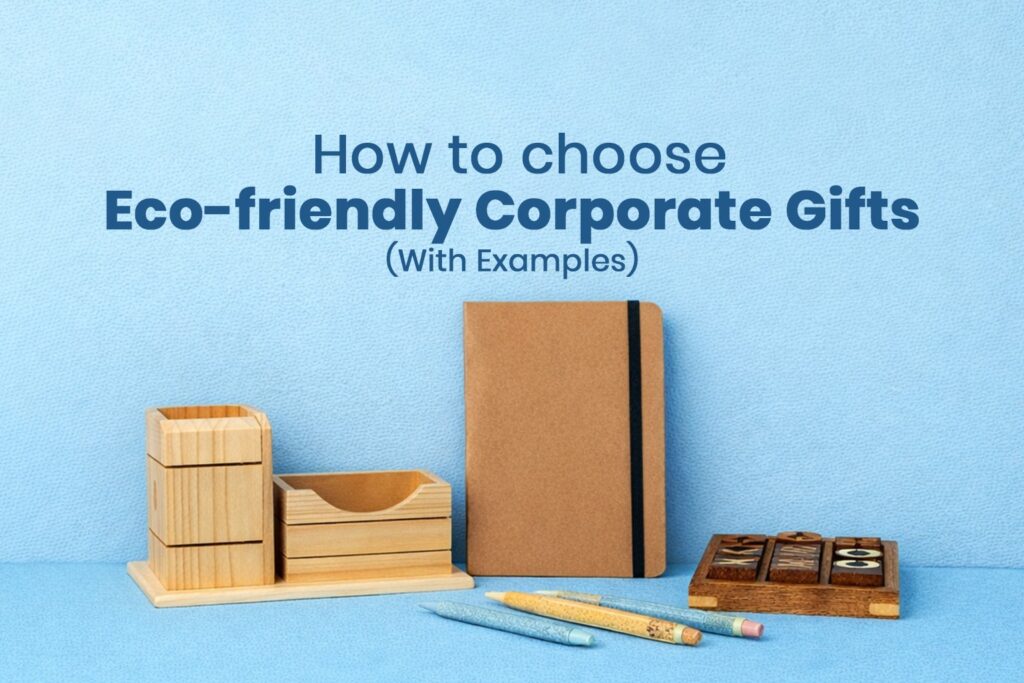
Materials like bamboo, recycled paper, recycled fabric, stainless steel, and glass tend to hold up better over time. They feel solid. They age naturally. They don’t need defending.
A recycled notebook that lasts months does more than a novelty product that talks about sustainability but feels flimsy after a week.
Good material choices communicate intent quietly.
Quiet communication is usually more believable.
Be careful with novelty, even when it looks responsible
Novelty is tempting.
It creates a moment. It photographs well. It feels different. But it also disappears quickly.
Many eco-friendly gifts fail not because they are unsustainable, but because they are unnecessary. Decorative items, fragile objects, or products with no clear purpose rarely survive long enough to justify their footprint.
Sustainability isn’t about creating excitement.
It’s about reducing replacement.
Durable, boring, useful items often outperform clever ideas over time.
Packaging reveals more than most people realise
Packaging is where intention becomes visible immediately.
Heavy boxes, plastic inserts, and layered wrapping undo a lot of good work. Even before the product is seen, the message is diluted.
Simple packaging tends to feel calmer. Cardboard boxes. Kraft paper. Cloth pouches. Minimal printing. These choices feel deliberate, not lazy.
There was a time when more packaging suggested effort.
That time has passed.
Today, restraint reads as confidence.
How a product is made still matters
Sustainability doesn’t stop at the product surface.
How something is sourced, manufactured, and assembled influences how it’s perceived, even if that information is never explicitly shared.
Locally sourced items, ethically produced goods, and responsibly made essentials tend to feel grounded. They don’t rely on storytelling. They rely on coherence.
When sourcing decisions align with how an organisation operates, gifts feel consistent rather than symbolic.
Sometimes the most sustainable option is not shipping anything
Physical gifts are not always necessary.
For remote teams, global workforces, or frequent recognition programs, digital rewards often make more sense. They remove packaging. They reduce logistics. They avoid unused inventory.
Digital vouchers and experience-based rewards work when they are framed as flexibility, not convenience. When people feel trusted to choose, the experience feels thoughtful rather than generic.
Sustainability isn’t always about adding the right thing.
Sometimes it’s about not adding anything at all.
Choice reduces waste more effectively than control
Fixed gifting assumes everyone needs the same thing. That assumption rarely holds.
Choice-based gifting allows recipients to select what they’ll actually use. This avoids duplication, prevents unused items, and reduces quiet waste that no one tracks.
From a business perspective, choice improves utilisation.
From a human perspective, it feels respectful.
Both matter.
Alignment matters more than one good gesture
Eco-friendly gifting works when it matches how the organisation behaves day to day.
If sustainability shows up only during gifting moments, it feels performative. If it shows up consistently in small decisions, it feels real.
Gifts don’t need to prove values.
They need to reflect them.
Consistency over time does more for credibility than any single well-executed initiative.
Scale is where good intentions usually break
Many sustainability efforts weaken as programs grow.
Products change. Quality drops. Deliveries slip. Processes fragment. What worked for a small group becomes unreliable at scale.
This is where structure matters.
Platforms like BrandSTIK, supported by FOXBOX Rewards, help organisations manage sustainable gifting with consistency. Curated eco-friendly collections, choice-based gifting, digital rewards, and responsible fulfilment create reliability across teams and locations.
Reliability isn’t glamorous, but it’s essential.
Final thought
Eco-friendly corporate gifting works best when it stops trying to make a statement.
Useful products. Durable materials. Simple packaging. Thoughtful timing.
These choices don’t demand attention. They earn it slowly.
When sustainability is embedded into everyday gifting decisions, it becomes part of how people experience the organisation. Over time, that quiet consistency matters more than any campaign or message ever could.
Call to Action
If sustainable gifting is important to your organisation, execution needs to match intent.
BrandSTIK helps teams plan and manage eco-friendly gifting programs that are practical, consistent, and scalable. From sustainable product curation to choice-based gifting and responsible fulfilment, the focus stays on doing fewer things better.
If you’re evaluating sustainable gifting for employees, clients, or partners and want guidance rooted in real execution, connect with us.
Connect with us today
Call: +91 9594070940
Email: info@brandstik.com
Visit: www.brandstik.com