

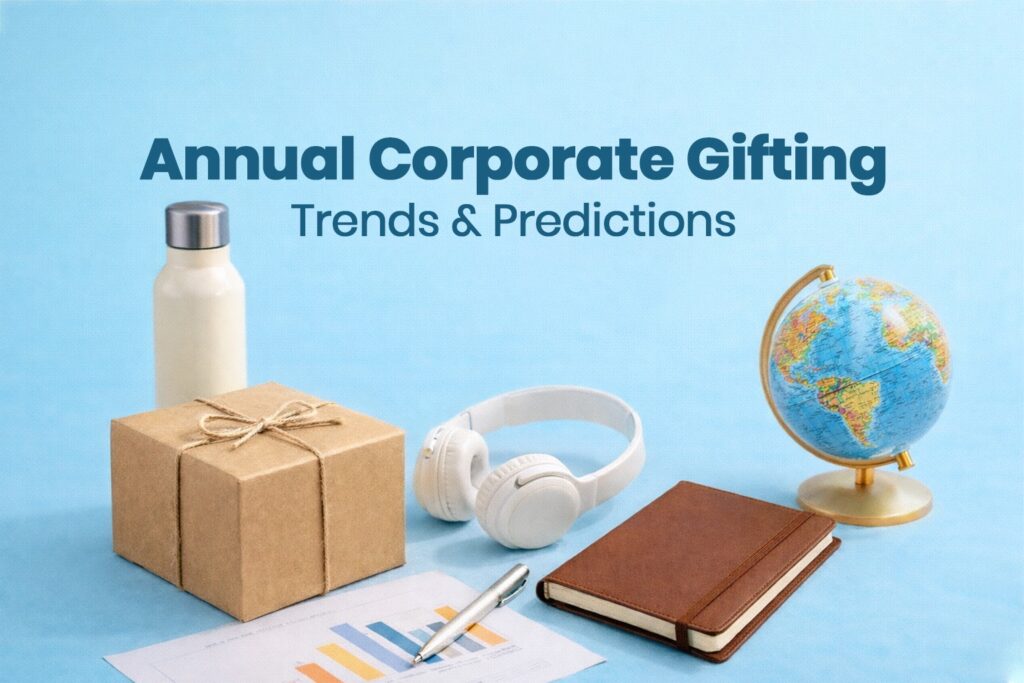
Corporate gifting has quietly shifted roles.
What once sat under administration now influences engagement, retention, brand perception, and culture. Across large organisations, gifting is no longer treated as a seasonal activity. It is planned annually, reviewed strategically, and measured for impact.
Looking at how enterprise teams design gifting programs today reveals clear patterns. These are the trends shaping corporate gifting this year and the signals organisations should plan around next.
Gifting Is Becoming Employee Centric by Design
Across distributed teams, the effectiveness of gifting increasingly depends on relevance.
Programs that perform well prioritise gifts that integrate into daily work or personal routines. Utility consistently outperforms novelty. Items that support productivity, wellbeing, or everyday use are retained longer and create stronger recall.
The implication is clear. Gifting works best when it respects how people actually work and live, not how organisations assume they do.
Choice Based Gifting Is Moving From Optional to Expected
Choice based gifting is no longer an experiment.
Across large-scale programs, allowing recipients to select their own gifts consistently reduces waste, improves satisfaction, and lowers operational friction. It also removes the risk of mismatched preferences across roles, locations, and seniority levels.
As teams become more diverse and geographically spread, flexibility has become a baseline expectation rather than a differentiator.
Digital Rewards Are Now Core Infrastructure
Digital rewards are no longer used only for convenience.
They are increasingly central to recognition, onboarding, and multi-location programs. Instant delivery, zero logistics dependency, and global accessibility make them especially effective for hybrid and remote teams.
High-performing organisations now treat digital rewards as a permanent layer within their overall gifting strategy, not a fallback option.
Sustainability Has Shifted From Messaging to Material Choice
Sustainable gifting has matured.
Instead of symbolic eco labels, organisations are focusing on materials, durability, and packaging restraint. Reusable products, minimal packaging, and responsibly sourced items consistently outperform decorative alternatives.
This shift reflects a broader expectation. Sustainability is judged by how a product is used and retained, not how it is explained.
Wellness Gifting Is Becoming Context Driven
Wellness gifting is no longer limited to occasional kits.
It is increasingly timed around workload peaks, project closures, or organisational change. Ergonomic accessories, self care products, and simple wellbeing tools perform best when they respond to real moments rather than calendar events.
The pattern is consistent. Wellness works when it feels supportive, not performative.
Personalisation Is Now a Baseline, Not a Premium
Across enterprise programs, basic personalisation has become table stakes.
Name-based messaging, milestone recognition, and role-specific relevance significantly improve engagement without adding complexity. Over-branding, however, continues to reduce retention.
Personalization succeeds when it feels human and restrained.
Gifting Programs Are Becoming Data Led
Visibility has become non-negotiable.
Teams now expect insight into redemption behaviour, delivery performance, and budget utilization. Data is used to refine categories, adjust timing, and improve consistency year over year.
As gifting scales, programs without tracking and reporting lose credibility internally.
Centralised Platforms Are Replacing Manual Coordination
Manual gifting processes struggle beyond a certain scale.
Centralised platforms allow organisations to manage categories, budgets, logistics, and reporting from a single system. This reduces coordination overhead and ensures consistent experience across teams and regions.
Efficiency is no longer the only benefit. Control and predictability matter just as much.
Multi-Location and Global Gifting Is the Default, Not the Exception
Distributed teams are now the norm.
Gifting programs increasingly span cities, states, and countries. This requires logistics models that support regional delivery, international fulfillment, and local compliance without fragmenting the experience.
Scalable fulfillment is now a strategic requirement, not an operational afterthought.
Budgets Are Being Used More Strategically, Not Necessarily Increased
The most effective programs are not defined by higher spend.
They are defined by clarity. Clear categories, tiered collections, and intent-based gifting deliver stronger outcomes than unstructured increases in budget.
Planning matters more than volume.
How Organisations Are Structuring Gifting at Scale
Across large programs, a few structural choices consistently reduce friction:
- Zero inventory models where stock is held centrally and shipped on demand
- Strategic warehouse networks enabling faster fulfilment
- On-demand shipping for both bulk office deliveries and individual home shipments
- In-house customisation to reduce turnaround time
- Pan-India and worldwide shipping supported by multiple premium courier partners
- Real-time tracking to maintain visibility across regions
These systems allow gifting to operate as infrastructure rather than an exception.
Conclusion
Annual corporate gifting trends point in one direction.
Gifting works when it is relevant, flexible, well-timed, and operationally sound. Programs designed around choice, sustainability, data visibility, and scalable fulfillment consistently outperform those built around products alone.
Organisations that treat gifting as part of their people and brand strategy rather than a yearly task see stronger engagement and long-term value.
Planning early, structuring clearly, and executing consistently is what separates effective gifting from forgettable gestures.
Connect with our experts to discuss how corporate gifting can be planned, managed, and scaled more effectively.
📞 Call: +91 9594070940
✉️ Email: info@brandstik.com
🌐 Visit: www.brandstik.com