

Tech gifts are easy to get wrong.
They look impressive on a catalogue page, sound exciting in internal decks, and tick the “modern” box quickly. But once they reach employees, many of them quietly disappear into drawers, backpacks, or cupboards.
Across corporate gifting programs, one thing shows up again and again.
Employees do not reject tech gifts because they dislike technology. They stop using them because the product does not fit into how they actually work.
In 2026, the most effective tech gifts are not innovative or flashy. They are dependable, familiar, and quietly useful. They solve small, recurring problems and do it without demanding attention.
This is what employees actually end up using every day.
Why Most Tech Gifts Don’t Stick
When tech gifts fail, it is rarely because of price or intent.
The failure usually comes from one of three places.
The product solves a problem employees do not really have.
It requires setup, explanation, or behavioural change.
It feels promotional rather than personal.
In busy work environments, anything that creates friction loses its place quickly. Even well-made tech gets sidelined if it interrupts routine instead of supporting it.
The simplest benchmark is also the most accurate.
If a tech gift is not used in the first few working days, it rarely becomes part of daily work later.
Tech Gifts That Employees Keep Using
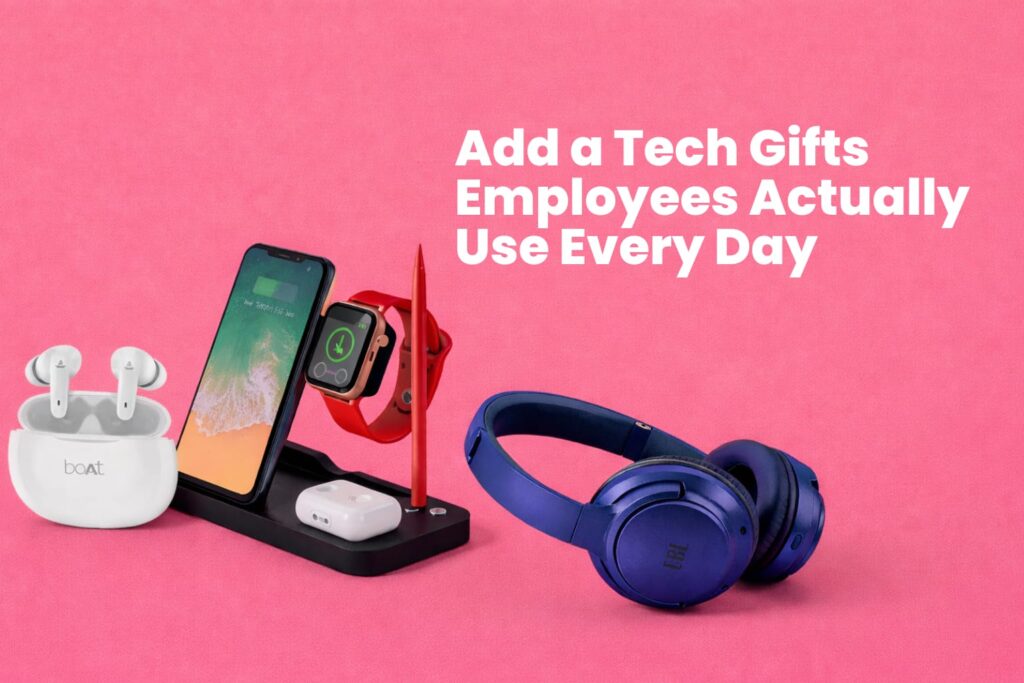
Wireless Chargers That Blend Into the Desk
Wireless chargers continue to perform well because they disappear into the workday.
They reduce cable mess, work across most phones, and sit comfortably on desks without instructions. When charging is reliable and the design is clean, employees stop thinking about the product and simply keep using it.
That quiet usefulness is the reason they last.
Power Banks That Support Unpredictable Days
Power banks remain relevant because workdays are no longer predictable.
They are used during travel, long meeting blocks, client visits, and remote work. Compact designs are preferred because they fit easily into bags and don’t feel like extra weight.
Employees keep them because they solve a problem exactly when it shows up.
Laptop and Phone Stands That Improve Comfort
Ergonomic accessories tend to earn their place slowly and then never leave.
Laptop and phone stands improve posture, reduce neck strain, and make long workdays more comfortable. They work just as well at home as they do in the office, which makes them especially valuable in hybrid environments.
Comfort, once experienced, is hard to give up.
Headphones Designed for Work, Not Entertainment
Headphones work best when they respect the work context.
Employees consistently prefer models that support focus, clear calls, and long wear over feature-heavy consumer designs. Noise cancellation helps in shared spaces, while lightweight headsets suit meeting-heavy roles.
The best ones do their job without drawing attention to themselves.
Tech Organisers That Create Order
Organisation is an underrated form of productivity.
Tech organisers that manage cables, chargers, and small accessories are used daily because they reduce mental clutter. Over time, they become part of how employees pack, travel, and set up their workspace.
Their value grows quietly through repetition.
Smart Desk Accessories That Don’t Distract
Not every smart device belongs on a work desk.
The ones that last are simple. Adjustable desk lamps. Compact port hubs. Minimal desk clocks. These tools support work without becoming the focus of it.
When smart accessories feel intuitive, they stay.
Privacy Tools That Address Real Concerns
Digital awareness has changed how employees think about privacy.
Webcam covers and screen privacy filters may seem minor, but they solve a real concern without effort. They are used because they respect personal boundaries in shared or remote work environments.
Small signals matter.
Branding That Doesn’t Get in the Way
Branding often decides whether a tech gift is used or avoided.
Clean design, neutral colours, and subtle branding lead to higher usage. Loud logos and bold brand treatments tend to push products out of daily workspaces faster.
Employees keep items that feel personal. They discard items that feel promotional.
Why Choice-Based Tech Gifting Works Better
Tech needs vary more than most programs expect.
Different roles, devices, work styles, and preferences make one-size-fits-all gifting inefficient. Choice-based tech gifting allows employees to select what fits their setup instead of adapting to the gift.
At scale, this reduces waste, avoids duplication, and leads to better long-term use.
Choice feels respectful. Operationally, it also makes sense.
Making Tech Gifting Work as Teams Grow
As organisations scale, informal gifting processes begin to strain.
Deliveries become inconsistent. Quality varies. Inventory piles up. Even good product choices lose impact when execution feels messy.
Structured systems help maintain consistency without adding friction. When tech gifting is treated as an ongoing program rather than a one-time activity, outcomes improve across engagement, efficiency, and perception.
Reliability is what employees remember.
Conclusion
The tech gifts employees use every day are rarely the most exciting ones.
They are the ones that fit naturally into work. They remove friction, support comfort, and quietly earn their place on desks and in bags.
When tech gifting focuses on usefulness, subtle design, and real choice, it stops being a gesture and starts becoming part of the employee experience.
At scale, relevance always wins over novelty.
For organisations looking to make tech gifting practical rather than ornamental, structure matters as much as selection.
Whether the goal is everyday utility, choice-based tech gifting, or consistency across teams and locations, the right system ensures gifts are used rather than forgotten.
Connect with BrandSTIK
📞 Call: +91 9594070940
📧 Email: info@brandstik.com
🌐 Visit: www.brandstik.com
Sometimes, a short conversation is all it takes to get it right.